Proposed protest limits at University of Hawaii trigger concerns
University of Hawaii President Wendy Hensel in the fall plans to release proposed changes that would impose new limits on speech and protests across all 10 UH campuses.
Read more Hawaii voter registration going from opt-in to opt-out
Hensel’s announcement of her intentions in November 2025 to update UH’s “time, place and manner” rules received immediate blowback from some students and faculty on the flagship Manoa campus, which has served as ground zero for student and faculty unrest going back at least seven decades to the 1960s.
The Manoa campus was the center of Vietnam War protests led by political science professor Oliver Lee, who served as the faculty adviser for a group of students outraged by U.S. involvement in the war. In 1968, Lee was threatened with the loss of tenure after students posted anti-war flyers around campus.
“This action triggered a historic 10-day student and faculty sit-in at Bachman Hall, the university’s main administrative building,” according to a 2019 article posted on the UH administration’s Hawaii News website.
Hawaii News in 2019 traced Manoa’s long history of demonstrations, beginning with Lee, to provide perspective for anti-Thirty Meter Telescope protests, saying Bachman Hall has a “long history of sit ins,” and calling them “a good tradition.”
Protesters in 1968 unofficially renamed Bachman “Liberation Hall” and occupied the lawn for 10 days, triggering “mass arrests and ultimately led to the resignation of UH President Thomas Hale Hamilton,” according to Hawaii News. “Following pressure and the threat of censure from the American Association of University Professors, Dr. Lee was granted tenure and successfully reinstated.”
Demonstrations in and around Bachman Hall — home to the offices of the UH president and UH Board of Regents that governs the UH system — have continued ever since.
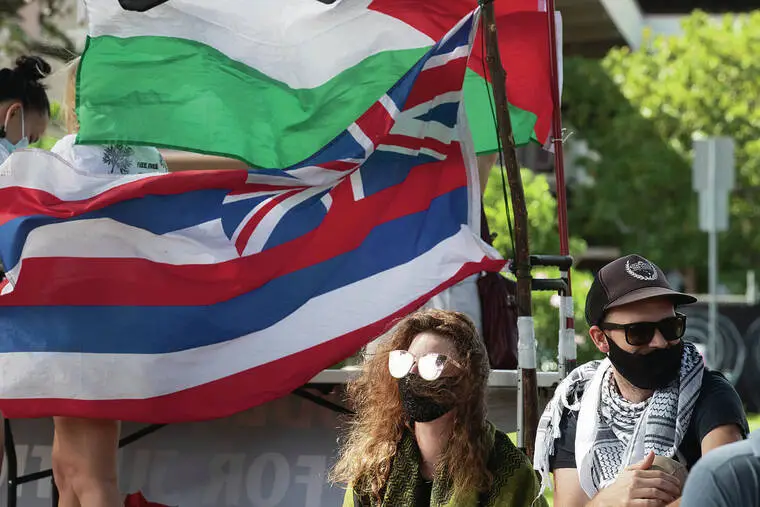
Previous Manoa protests include fallout from the decision by the Board of Regents in 1974 to rename Manoa’s Social Sciences Building “Porteus Hall” to honor psychologist Stanley Porteus — a name change that triggered demonstrations over his 1926 book, “Temperament and Race.” Other protests have included more recent demonstrations in opposition to Trump Administration policies that ban federal funding for diversity, equity and inclusion programs.
UH had celebrated DEI before Trump returned to power in 2025 and began slashing millions in federal research money. The university responded by canceling dozens of programs. Hensel’s efforts to prohibit demonstrations inside Bachman Hall represents a continuation of the fallout.
Other proposals under consideration by Hensel would:
• Limit public demonstrations to noise levels of 60 decibels, which critics say is equivalent to a conversation.
• Ban overnight camping and tents on campus — such as the global “occupy” movements.
• Distancing limits regulating how close demonstrators could get to UH buildings.
Hema K. Watson, who’s majoring in political science and Hawaiian studies, served as UH-Manoa’s student body president in the fall when Hensel announced the changes.
His parents and uncles and aunties all joined campus protests in their day, and most of them consider Hensel’s proposals “rubbish,” Watson said.
Each of the UH demonstrations of the past, along with ongoing protests, “would not be possible,” Watson said. “We would be shut down so quickly.”
The proposed changes send the message that UH does not “want to protect the ability of students to voice their concerns and occupy campus spaces at a time (Trump’s second term in office) when there’s a very real threat,” he said.
Incoming UH-Manoa senior Zane Castillo broke the story of the proposed changes in the student online publication called the Manoa Mirror — an alternative to its older student-run competitor, Ka Leo.
“I interviewed students and a lot of them were unaware of the UH policy proposal,” Castillo said. But after he showed students a copy of the plan, Castillo said, “this was very scary for them.”
It’s considered what UH calls “executive policy” that is not expected to go before UH regents for their input or consideration.
Board of Regents President Gabe Lee did not respond to requests for comment over whether the board may get involved.
UH spokesperson Dan Meisenzahl said he confirmed that regents do not review “executive or administrative policies.”
UH officials insist that what comes out in the fall will merely be another proposal that will give faculty, staff and students across all campuses another opportunity to respond.
Once finalized, the new rules will still be considered “an interim policy” open to future review, according to Debora Halbert, UH’s vice president of academic strategy.
“After the first proposal went out last fall,” Halbert said, “we did a round of revisions and those were submitted back out to the Faculty Senate in the spring semester and then that version was submitted to the unions for consultation — and UHPA (the University of Hawaii Professional Assembly faculty union) specifically.”
The UH-Manoa Faculty Senate in February responded by voting overwhelmingly — 52 to 3 — to oppose Hensel’s proposal. UH law school faculty voted to submit written comments, including feedback on language in the draft they said could be interpreted as violating rights guaranteed in both the U.S. and Hawaii constitutions.
Read more From South Kohala, to Antarctica, to UH board
After the latest draft is released in the fall, Halbert said, “What we’d like to do is then have an interim policy, and then we’ll go back out and have more conversations about the changes that are being put into place. We already do have this policy on the books. It’s just been a while since it’s been updated, and it doesn’t have the level of specificity our new policies do.”
Students and faculty upset by the proposed rules believe they were triggered by Trump Administration efforts to cut federal funding.
“I can’t say that it’s not part of the conversation,” Halbert said. “I can say for myself, this hasn’t been the primary entry point for it.”
UH political science associate professor Dean Saranillio teaches about “settler colonialism, labor, militarism and empires” and said he also serves as vice chair of the Manoa Faculty Senate’s “committee for professional matters that is charged with protecting academic freedom of all scholars.”
Saranillio helps to organize nonviolent student demonstrations that would be shut down under the proposed rule changes.
Last March, he encouraged students to “fill in the blank” — in chalk on the steps leading to the busy Campus Center — to answer the question of what “kills fascism.”
“Four hundred students showed up and they wrote, ‘Guitars kill fascism,’” Saranillio said. “Or they wrote, ‘Diversity kills fascism. Equity kills fascism. Inclusion kills fascism.’
“The day after, we were told that using the vertical steps (of the Campus Center) to chalk would no longer be permissible,” Saranillio said. “Historically, students had long used the steps and the university itself had used the steps to chalk, like on orientation day.”
Saranillio also helped organize another of what he calls “art actions” in response to Immigration and Customs Enforcement efforts in Minneapolis after two protesters were shot to death in January. Students were asked to describe “what happens when ICE melts?”
Responses in chalk included “When ice melts education grows” or “When ice melts dreams grow,” Saranillio said. “The very next day, on Nov. 14, the university then sent the entire campus a message that said, ‘No,’” he said. “Chalking is no longer allowed.”
Saranillio, 46, grew up in Kahului, Maui, in a family with a rich history of mobilizing and organizing plantation laborers.
His grandmother on his mother’s side, Masako Inouye, was a strike captain in the 1950s at the Hawaiian Commercial &Sugar Co.’s Camp 3 in Spreckelsville.
His great-grandparents on his father’s side, Sabas and Crispine Saranillio, had supported striking pineapple workers on Lanai by distributing food donated by hunters, fishermen and farmers.
“That’s how they were able to sustain their strikes so that they won,” Saranillio said.
When he was accepted as a freshman at Manoa to major in ethnic studies in 1997, Saranillio’s mother told him the story of the protest that ended when Lee retained his tenure.
On his first day at Manoa, Saranillio stepped off a campus shuttle and saw students protesting Porteus’ name on the former Social Sciences Building and called the protest “inspiring that they could exercise their free speech in that way.
“I just fell in love with the possibilities at the university,” Saranillio said. “The honesty and integrity of that protest really helped me understand that the university is a place that allows for that.”
When he was hired four years ago to teach at UH-Manoa, his mother, Eloise, reminded him about Lee — and told him that she had witnessed the protests as a UH student.
“She was amazed he (Lee) took such a strong stand,” Saranillio said. “I had heard the story, but I didn’t know my mom was there.”
His mother, who has since died, emphasized to Saranillio that “there is a responsibility in being a professor at UH and that holding that position requires integrity that also required me to speak up,” he said.
As a student, one of Saranillio’s mentors was the late UH professor Haunani-Kay Trask, an outspoken activist, who was also a founding director of UH’s Center for Hawaiian Studies, which has been renamed the Kamakakuokalani Center for Hawaiian Studies. Just like Lee, “they were constantly trying to take away her tenure,” he said.
He plans to help stage protests in the fall ahead of the release of Hensel’s latest proposal.
Saranillio lives in faculty housing at Manoa with his 8-year-old daughter and 11-year-old son. While he worries UH may also go after his tenure as well as his faculty housing, he remains undeterred.
“I was talking with my daughter about it and she said, ‘How does it make sense to have a protest that no one can hear?’”
Read more USMNT beats Australia, soars into World Cup knockout stage; How’d they do it without Pulisic?