Puna Alternate Route Study underway but delayed
Publication of a state and Hawaii County-funded traffic study exploring alternate routes into Puna District has been delayed by at least half a year, according to the county Department of Public Works.
Read more Iran draw strength from adversity after holding Belgium to draw
Publication of a state and Hawaii County-funded traffic study exploring alternate routes into Puna District has been delayed by at least half a year, according to the county Department of Public Works.
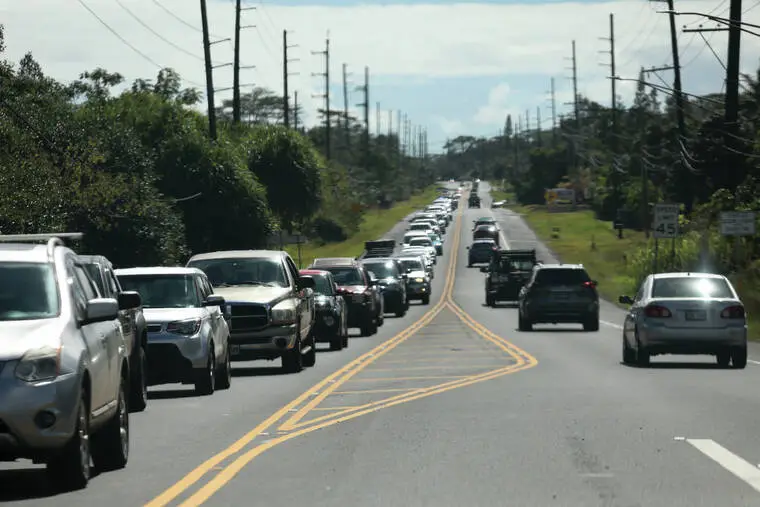
The Puna Alternate Route Study is a $1.9 million push to alleviate chronic traffic congestion along Highway 130 and provide more emergency evacuation options in a district known for its recent destructive lava flows and rush-hour bottlenecks clogging some two-lane sections if its lone highway.
The study will analyze six different prospective alternative roads — three mauka and three makai — which supporters have championed as a way to cut down on notoriously long daily commute times and provide access out of the district should Highway 130 be blocked or threatened, like it was during both the 2014 and 2018 lava flows.
Proposed routes will be evaluated based on engineering feasibility, land use and natural resource protection considerations, and must not cross Department of Hawaiian Home Lands properties due to legislative requirements set forth by a County Council resolution.
Those restrictions stem from protests staged by DHHL residents against potential makai routes running through their properties, specifically in the Panaewa and Keaukaha communities. Those disputes became so intense that they pushed the council to outright reject the study’s initial funding in January 2024, which ended up stalling the project for over a year.
Residents claimed that their neighborhoods were already disproportionately affected by established infrastructure, including the Hilo International Airport, Hilo Landfill and transfer station, an industrial raceway park and wastewater treatment facilities.
DPW plans for a steering committee comprised of county officials and community leaders — including the community associations of several Puna subdivisions — to guide the work, with at least three informational meetings to be held for the public to share feedback and hear progress updates.
Honolulu-based consulting firm Wilson Okamoto Corporation secured the contract to conduct the study in May 2025, which originally required completion of work and submission of a final report by December 2026, according to county officials at the time. A DPW spokesperson told the Tribune-Herald last week that the contract allows for this deadline to be extended, saying that the results are now scheduled to be published in “the latter-half of next year.”
“Preliminary analysis has been performed for both mauka and makai route options, and an advisory committee is being finalized,” he said. “Following the advisory committee meeting, a public meeting will be held to present preliminary route options for public input.”
According to DPW, the department is currently working with state officials to transfer $1 million in state funds earmarked for the study, which will be combined with the $1 million in county capital improvement project funds that have already been spent. Previous reporting stated the contract was awarded for $2.5 million.
State Rep. Greggor Ilagan of Puna helped secure the state’s contribution to the project in its most recent budget, just like he did in 2022, when the money ended up being declined by the council two years later. At the time, he described this inaction as showing “a lot of disrespect,” calling the council members’ grandstanding “not professional.”
Read more McGuire reflects on new BIIF Executive Director role, time as Kea‘au High AD
“The money that I secured the first time did not get released because the county rejected it and didn’t accept it, so I had to re-secure additional funds,” he said.
He pointed out how difficult it was to free up the money in the first place only to watch it be derailed by a simple procedural vote — one which he characterized as “political.” When asked if he thinks it’s reasonable to require the study to omit all DHHL parcels, he responded with a resounding “no.”
“I think it was premature and it lacks the ability to have a more comprehensive plan that helps everybody,” Ilagan said. “I think this phase of development is where we need to gather the data and understand what are the best decisions out of the facts that we can find.”
Attempting to explain his disagreement with the council, he said it’s possible to develop a road plan that satisfies all stakeholders.
“If there is Hawaiian Home Lands property that is not developed, and there needs to be roads to go through that undeveloped property, and if we build that infrastructure to help build housing in that property, then would that be a justification for some sort of exchange between building out roads and building out homes?” he asked. “They can go together.”
“To say that we don’t need to study something because we just don’t want to know what the answer is is not the best way to make community decisions,” he added.
He said the rapid growth of Puna is creating a critical need for more roads, especially for commuters, who constantly reach out to his office demanding relief. He said chronic traffic jams have been one of the most frequent constituent complains he’s heard for the past several years.
“Highway 130 is just not accommodating the number of people that’s on our roadways, and we need more road infrastructure for that,” he said. “The traffic congestion that is happening in Puna every year and growing (is) because it’s the most affordable place to live, and there is more and more traffic. The alternate route will provide another commute roadway back and forth.”
He said he hopes the state’s contribution to the study will be used to gather detailed data which county funding alone could not have afforded.
“For example, I want them to track where the cars are actually going so … if we were to figure out how to align these roads, then we’d know that the most traveled-to location is, let’s say, the mall, or Target or Walmart,” he said. “We have the money, and we might as well use it and make the plan the best as possible with our existing resources that we allocated.”
Read more Salah delivers Egypt historic first World Cup win; Are Pharaohs on crash course with USA?
Email Stefan Verbano at [email protected].