New Hawaii laws address domestic violence, human trafficking
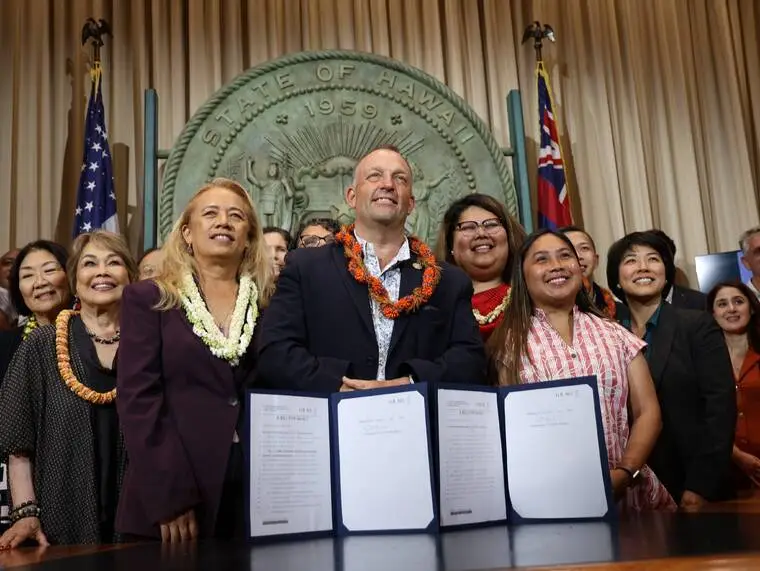
In a ceremony Tuesday at the state capitol in Honolulu, Gov. Josh Green signed into law a pair of measures introduced as part of the Women’s Legislative Caucus package.
Read more MLB roundup: Mets nip Braves in 11 to split 4-game series
In a ceremony Tuesday at the state capitol in Honolulu, Gov. Josh Green signed into law a pair of measures introduced as part of the Women’s Legislative Caucus package.
House Bill 1959 extends a five-year pilot project intended to decrease repeated incidents of domestic violence, while HB 1960 would establish a program to educate and train transient accommodations workers to recognize human trafficking and report suspected incidents.
Green, a longtime Hawaii Island emergency room physician, referred to the legislation as “critically important bills” he said “will decrease the number of people who end up in dire straits.”
“The things I saw in the early 2000s on the Big Island when I was in the ER were often unbelievable, just the amount of violence people would often absorb because of domestic violence or clearly circumstances in which young people were being trafficked — it was heartbreaking … ,” Green said. “There were many times when I would see an individual patient, and I knew in my heart something was wrong, even beyond the injury that had occurred. But I didn’t feel equipped at the time to have enough information to know where to turn, or perhaps to seek help.”
HB 1959 establishes a petty misdemeanor offense for the least serious incidents of domestic abuse and allows judges to defer acceptance of guilty pleas for misdemeanor and petty misdemeanor abuse convictions. That would allow the conviction to be stricken from the record after a period of compliance with court-ordered remediation.
The law, which is already in effect, also requires the state Judiciary to submit yearly reports to the Legislature including, among other provisions: the final outcome of each case, including the number of cases dismissed, deferred with a successful case closure, and sentenced, by category; the number of domestic violence assessments ordered and completed and the number of defendants referred to treatment after assessment and outcomes; and any new charges for defendants while their case is open and for a year after treatment.
The final report, due on Dec. 1, 2030, will assess the pilot project and determine if further legislation is necessary, including whether to make the pilot project permanent.
Sen. Lynn DeCoite, a Maui County Democrat, assistant majority floor leader and co-convener of Women’s Legislative Caucus, described domestic violence as “real for all of us.”
‘Too often these victims, many of them women and children, go unseen,” DeCoite said. “By increasing awareness and strengthening in reporting, we are creating safer spaces through our islands and giving more victims the opportunity to be identified and receive help.”
DeCoite acknowledged state Sen. Joy San Buenaventura, a Puna Democrat who wasn’t present but whose leadership, she said, “has been instrumental in advancing the domestic violence pilot program.”
“Before this pilot program, survivors often waited months for their cases to move forward,” she explained. “They’re repeatedly called back to court — only to have their hearings continued, forcing them to miss work, arrange babysitting, childcare, and relive their trauma time and time again. Many victims felt they were being victimized, not only by their abuser, but also by the court process itself.
“Today, because of the pilot program, cases are moving through the courts more quickly. Survivors receive faster resolutions, and offenders are required to participate in domestic violence intervention programs. And guilty pleas include an acknowledgement of the cause they harmed.
Read more 2026 Vulcans volleyball schedule released
“Those timely consequences have helped reduce repeat offenses, while providing families with a more effective path toward healing, accountability and, when appropriate, opportunity to move forward.”
Angelina Mercado, executive director of the Hawaii State Coalition Against Domestic Violence, said the new law “is an important step but it cannot be the last one.”
“Survivors also need the economic security to leave dangerous situations,” Mercado said. “That means continuing our work to enact paid family and medical leave, expand access to childcare, (and) increase the supply of affordable housing so survivors have real options and meaningful support.
“Over the next five years, we’ll carefully evaluate this pilot program to determine whether it improves survivor safety, strengthens community safety, and increases offender accountability,” she said.
HB 1959 requires the Department of the Attorney General to implement a human trafficking awareness program to educate and train workers in the transient accommodations sector. It also requires industry employers or contractors to keep records of the training, post signage and to develop and implement a human trafficking prevention policy that includes procedures for reporting suspected trafficking.
The new law imposes civil fines of up to $100 for noncompliance.
Green, who called trafficking “a silent epidemic, from a lot of people’s perspective,” said he understands the fines seem inconsequential, but added, “Just to know that we will be able to do something more quickly is good. And it will help us, because it’s been very difficult to prosecute cases.”
A 2020 Arizona State University study commissioned by the Hawaii Commission on the Status of Women found approximately 150 high-risk sex trafficking establishments operating in Hawaii — predominately in Honolulu — and that roughly 1 of 11 men over 18 in Hawaii have gone online to purchase sex.
The research also found Native Hawaiian women and girls are disproportionately represented among trafficking victims — with later surveys finding up to 64% of identified victims had Native Hawaiian ancestry.
“The Department of the Attorney General is currently working on a human trafficking report,” said Rep. Linda Ichiyama of Oahu, House vice speaker and co-convener of the Women’s Legislative Caucus. “And last year, their report covered commercial sexual exploitation of children, focusing on those victims who were 18 years and younger. And that report is available on the attorney general’s website. This year, this December, we’re looking forward to a comprehensive report on human trafficking — both children and adults, both labor and sex trafficking.
“To add on to what Gov. Green said, a lot of times, trafficking victims don’t see themselves as victims. They think that this is their way of making money or their own prerogative, and they don’t see the power and control dynamic that’s often happening.”
In addition, Green on Tuesday signed into law two vaping-related bills.
Senate Bill 2175 makes the sale of disposable electronic smoking devices illegal starting Jan. 1, 2027, imposing $100 per day penalties for violators.
And HB 1573 requires sellers of electronic smoking devices and e-liquid to have received certification from the U.S. Food and Drug Administration, and that the manufacturer is in compliance with federal regulations and state laws. That new law imposes civil penalties of up to $2,000 for repeat offenders.
Read more Hawaii fast-tracks pilot recruiting efforts as aviator shortage looms
Email John Burnett at [email protected].

Related Posts

Remembering Hawaii’s 9/11 victims

World Manta Day returns today
