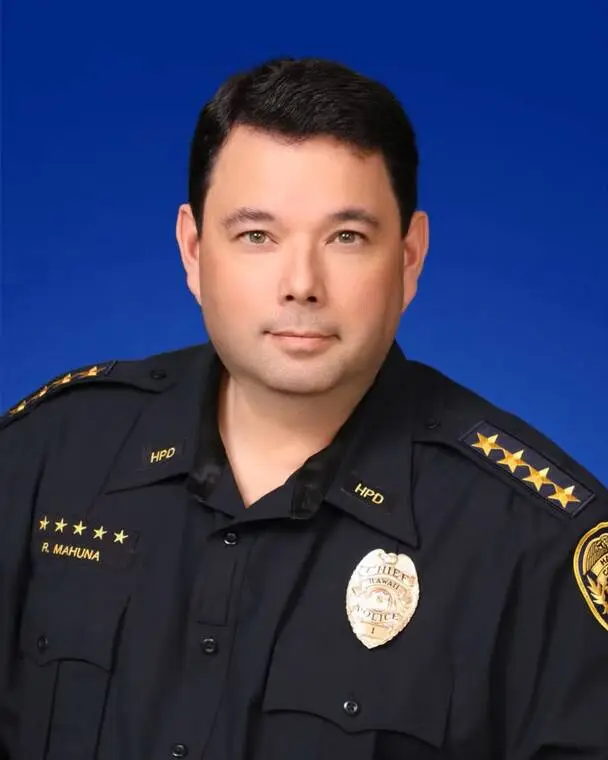
HPD changes its stance on medical marijuana cards and guns
The chief of the Hawaii Police Department confirmed in a recent letter that people who possess a medical marijuana permit will no longer be categorically disqualified from legally possessing firearms.
The chief of the Hawaii Police Department confirmed in a recent letter that people who possess a medical marijuana permit will no longer be categorically disqualified from legally possessing firearms.
The June 29 letter from Chief Reed Mahuna to Dr. James Berg said the Hawaii Police Department has reviewed the U.S. Supreme Court’s recent decision in the U.S. vs. Hemani case and “will ensure that our firearm permitting policies conform to the court’s ruling.”
The justices, in a 9-0 ruling on June 18, upheld a lower court’s decision to dismiss an illegal gun possession charge brought under the federal Gun Control Act against Ali Hemani, a U.S.-Pakistani dual citizen and Texas resident who told authorities he was a regular marijuana user.
The Gun Control Act, passed in 1968, outlawed the possession of firearms by anyone who “is an unlawful user of or addicted to any controlled substance.”
“Consistent with that decision, possession of a valid medical cannabis license will not be treated as an automatic disqualifier for a permit,” Mahuna’s letter stated. “Any determinations will be made in accordance with applicable law and based on individualized assessment rather than any blanket disqualification.”
For HPD, that represents the softening of a longtime policy that prohibited the issuance of firearms permits to compliant medical cannabis permit holders.
A letter dated May 4, 2021, from then-chief Paul Ferreira to Berg stated that federal law and current FBI policy made “possession of a medical marijuana card within the past year … reasonable cause to believe that the person is a current unlawful user of a controlled substance and thus prohibited from the possession of firearms.”
Mahuna was off-island Thursday, but Deputy Police Chief Sherry Bird told the Tribune-Herald that in issuing firearms permits “there’s a whole variety of factors to consider, (and a) medical marijuana card is just one of them.”
“If the only thing a person has is a medical marijuana card, we’re not going to decline an application just based on that alone,” Bird said. “There’s other factors — their criminal history, are they under a protective order or restraining order, is there any kind of mental illness or treatment, drug addiction. Those are the variety of factors that we have to look at.
“We’re committed to abiding by the court’s decisions, so possessing the medical marijuana card will not be a disqualifier by itself.”
Read more Hawaii Island lawmakers share priorities, concerns at town hall
Mahuna’s letter was in response to a June 19 letter from Berg, founder of Greener Healing Ways and a longtime certifying physician for medical marijuana cards.
Berg said in a statement Thursday that for years, he received numerous firearm permit medical certification forms from patients who were legally registered in Hawaii’s medical cannabis program and was concerned about law-abiding medical marijuana patients being denied gun ownership solely because they possessed a state-issued medical cannabis permit.
In his letter to Mahuna, Berg said the high court “has now made it clear that the government may not rely on broad assumptions that all marijuana users are dangerous or unfit to possess firearms.”
Conservative Justice Neil Gorsuch, who authored the Hemani decision, wrote that the government had failed to show that its prosecution of Hemani complied with the U.S. Constitution’s Second Amendment right to “keep and bear arms.”
The ruling stopped short of precisely defining the bounds of that legal provision, including which types of drugs, if any, pose a special risk of misuse of guns. But the court, which often has taken an expansive view of Second Amendment protections, said the government’s failure to even allege that Hemani was an addict or show that his marijuana use made him a danger to himself or others all but doomed its case.
Hemani was charged in 2023 following an FBI raid of the home he shared with his parents in Denton County, Texas, in which agents found a Glock 9mm pistol, marijuana and cocaine.
Hemani said he used marijuana about every other day, though authorities didn’t accuse him of being impaired at the time of the search.
In his letter to Mahuna, Berg wrote that he supports reasonable safeguards.
“Firearm permits should not be issued to individuals who are intoxicated while handling firearms, who are addicted in a way that creates danger, who have a disqualifying criminal history, who are subject to restraining orders, who have serious mental instability involving dangerousness, or who present specific and articulable evidence of risk,” he said. “But lawful medical cannabis status alone is not such evidence.”
Berg said Thursday that his advocacy of the elimination of a medical cannabis license as an automatic disqualifier to legal gun possession “has always been about fairness.”
“Patients who follow Hawaii law deserve to have their applications evaluated based on the individual facts of their case — not on an automatic assumption tied solely to their status as a registered medical cannabis patient,” he said.
Read more Council votes to tweak bill regarding PONC funds
Reuters contributed to this story.
Email John Burnett at [email protected].

Related Posts

Remembering Hawaii’s 9/11 victims

World Manta Day returns today
