Concerns rise about invasive beetle
A Kona community development group on Tuesday heard warnings about the highly destructive Coconut Rhinoceros Beetle from an invasive species biologist — alerts that have taken on a new sense of urgency after one of the bugs was found July 6 at Hilo International Airport.
Read more American League dominates in an All-Star Game both anticlimactic and uncertain
A Kona community development group on Tuesday heard warnings about the highly destructive Coconut Rhinoceros Beetle from an invasive species biologist — alerts that have taken on a new sense of urgency after one of the bugs was found July 6 at Hilo International Airport.
Discovery of the dead adult female beetle inside one of the airport’s detection traps has sparked a scramble to head-off what the presenter, Big Island Invasive Species Committee Program Manager Franny Brewer, fears could be a new cluster of the pests.
She shared the troubling news with members of the Kona Community Development Plan Action Committee during their monthly meeting, who asked questions about mitigation efforts like green waste pile removal and insecticide application.
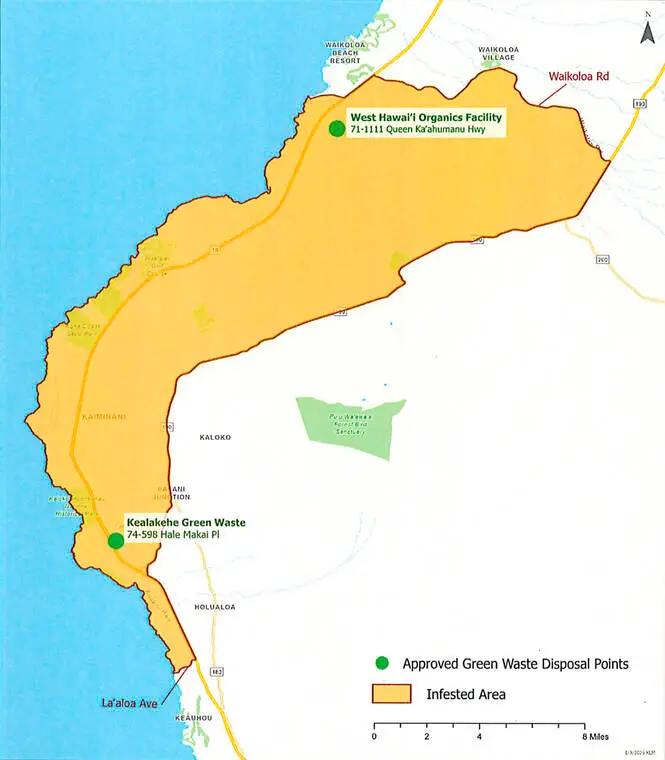
The Hilo airport find is only the second CRB detection outside of a quarantine area recently established along the Kona Coast spanning from Waikoloa Road to the southern portion of Ali‘i Drive.
In July 2025, a dead beetle was discovered inside a Hilo retail store selling bagged mulch and soil, which experts believe was shipped dead from Oahu. This is a stark contrast from this month’s CRB find, which was alive when it crawled into the trap and could have previously laid eggs.
“This is the one that we’ve been really worried about,” Brewer told the Tribune-Herald. “So, I still have my fingers crossed that this will be a single beetle and we won’t be finding additional ones, but you know, unfortunately, this just shows how vulnerable we are.”
When asked how she reacted to news of the discovery, she said it was a somber moment in a desperate, years-long fight against the horned invaders.
“I burst into tears, as did several of my staff,” she said. “It’s very emotional when you’re involved in these things. My team has spent hundreds of hours on this in the last couple of years, and this is something we’ve been dreading — having the beetle get to the east side is something that we’ve dreaded.”
CRB is an invasive insect responsible for causing extensive damage to palms and other plants across the Hawaiian Islands, where it threatens native species like hala and the endangered loulu (native fan palm).
The large armored bugs also attack food crops like taro, banana, breadfruit, papaya, pineapple, date palms and sugarcane, with reports of hungry adult beetles in heavily infested areas even going after mango trees.
Native to South Asia, CRB has killed or damaged more than 1,000 coconut palms across Oahu in the past decade.
It was first found on Hawaii Island in the Waikoloa area in October 2023 and — after almost two years of little to no detection — the number of adult and larval beetles tallied in north and central Kailua-Kona began to tick up significantly starting in mid-2025.
An on-site inspection of Keahole Agricultural Park by several different agencies last July uncovered two active breeding sites at a landscape nursery, discovering 110 late-state larvae and three adult beetles. Since then, officials had been steadily finding an average of roughly 20 adult beetles per month in the area along with varying numbers of larvae.
Brewer worries that the recent airport find could signal the establishment of a new breeding site far from this region where CRB was initially introduced. Researchers have hypothesised that the beetle likely stowed away aboard an airplane coming from Oahu, rather than transplanting from the established Kona cluster.
Read more Hearings set for men charged in attempted murder case
“There’s a chance that an adult beetle can simply hitchhike if it lands on a piece of cargo,” she said. “It’s not anything that’s plant-related — not anything that’s being inspected — but just, you know, the way you might see a fly or a mosquito just land on something, right? If it lands on a piece of cargo and gets loaded into the hold of a plane, we might not have any way to really intercept that.”
She said the ideal situation — one that poses the least threat to East Hawaii — is that the bug was a “lone hitchhiker” who came to the island solo and didn’t lay eggs before becoming trapped.
“That for me right now is a hopeful scenario,” she said. “Maybe that’s what we have on our hands: One beetle flew into a plane as it unloaded. It’s just one beetle. It’s not a breeding population. It wasn’t larvae that was moved here. That’s what we’re hopeful for, because that would be the best case scenario for what’s going on in Hilo.”
Even so, the fact that the specimen was an adult female risks that it was “gravid” — a biologist term meaning pregnant or carrying developing eggs.
“One of the things I don’t love so much about this is it was a female beetle,” Brewer said. “So, if this were a gravid female where she had eggs before she left Oahu, there’s a possibility she could have laid eggs before she flew into the trap, right? So, even when it’s a lone hitchhiker, if it’s a female there’s also that risk factor that we worry about. There’s a lot of different factors that could be at play here, and really there’s no way to know until the next beetle turns up or doesn’t.”
If the CRB did lay eggs out in the open before entering the trap, she said it could take four to six months before the hatched grubs pupate and emerge as adults.
“It’s a long time, so it’s very nerve-wracking,” she said.
In the meantime, state and county invasive species officials are doubling down on efforts to catch any remaining larvae or adult beetles around the Hilo airport, including deploying loads more traps and using scent-detection dogs to sniff out larvae in mulch piles.
Since July 9, she said BIISC has conducted roughly 10 miles of “dog surveys.”
During Tuesday’s meeting, committee vice-chair Nancy Pisicchio asked Brewer what types of “control mechanisms” were available to stop CRB’s spread.
Homeowners, she responded, can use different types of insecticides to kill adult beetles and larvae in compost piles, although she admitted many gardeners feel this defeats the purpose.
“There are some products labeled (for use) in your home compost, but of course they’re insecticides, so a lot of people … don’t necessarily want to kill every single bug that’s in that compost,” she said.
Meanwhile, commercial outfits are restricted to heat-treatments, she said, which involves heating green waste piles to 130 degrees Fahrenheit to kill any larvae.
Kailua-Kona resident Janice Palma-Glennie attended the meeting via Zoom and wondered how illegal green waste dumping could be contributing to the region’s growing CRB infestation.
“That’s something we’ve talked about with the county Department of Environmental Management,” Brewer said. “There are long stretches of this island where it would take 45 minutes for someone to take green waste (for proper disposal). There’s no place to take it, and so this is a bigger problem that they have to work on.”
Read more 4 with Hawaii ties get the call during the MLB draft
Email Stefan Verbano at [email protected].

Related Posts

Remembering Hawaii’s 9/11 victims

World Manta Day returns today
