A trio of traveling superstars reaches its destination in Cooperstown
COOPERSTOWN, N.Y. — The Hall of Famers take their spots on the stage here in random order. It is fitting for a place where all members are considered equals. There is no higher honor, no distinctions among the immortals.
Read more Sylvia Luke bribery case could be a hard one to prove, legal observers say
David Ortiz, the big slugger, batted leadoff on Sunday, the first of the record 60 Hall of Famers in attendance. Rod Carew, an elite top-of-the-order hitter, was introduced much later. He is 80 and cannot move like the kid who used to love stealing home. Ortiz, who is three decades younger, rose from his chair and gently helped Carew to his seat.
Ortiz, of course, was a titan for the Boston Red Sox. But he reached the majors with the Minnesota Twins, Carew’s primary team, and they are brothers in that fraternity. Single-team stars have a special glow, but most players get around — and the smart ones take things from everywhere.
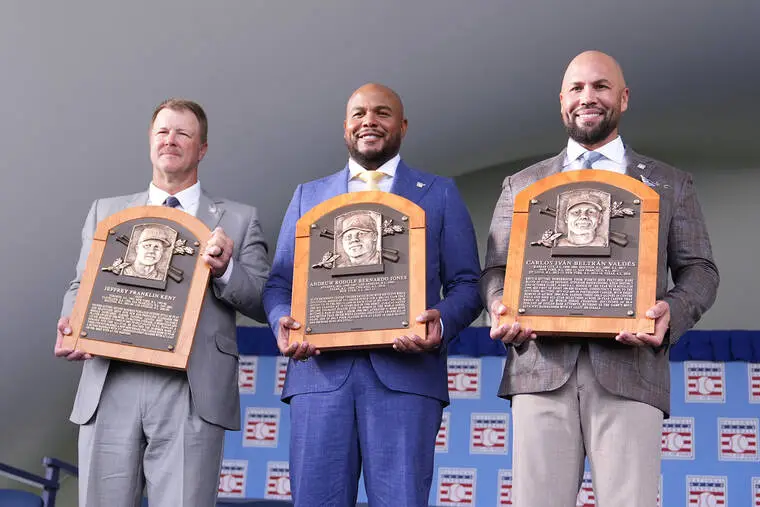
This year’s class was especially active in its travels. Carlos Beltrán played for seven teams, Jeff Kent played for six and Andruw Jones played for five. All are richer for the journey.
“Every single teammate that I played with, you guys were so important to me,” Beltrán said from the podium at the Clark Sports Center. “One of the biggest blessings for me was that I played for many organizations.”
At the start, Beltrán thought he might stay forever with the Kansas City Royals, like George Brett, who told him as a rookie that he could someday reach Cooperstown. But the Royals, who never won much with Beltrán, traded him to Houston in 2004.
If he’d stayed with Kansas City, Beltrán might never have known that he was built for the postseason, where he slashed .307/.412/.609 for five teams. And he never would have signed with the New York Mets, the team he represents on his plaque and might soon lead as manager.
“Every organization shaped (my) career; New York shaped my life,” Beltrán told the crowd. “It was here where I experienced my greatest success and some of my greatest challenges. … It represents a place where I became the best version of myself.”
Beltrán had the most vocal supporters on Sunday, though fans from his native Puerto Rico seemed to cheer more heartily than those from Kansas City, New York or his other teams. The Hall estimated a crowd of 12,000; last year, with Ichiro Suzuki and CC Sabathia as headliners, it was 30,000.
Each new inductee felt enough of a connection to one team to turn down the option of a blank cap on his plaque. Besides Beltrán, Kent went in as a San Francisco Giant and Jones as an Atlanta Brave. But all came to bat thousands of times for other teams, including Jones’ two final seasons in Japan.
“That was the end of my career and I felt like I wanted to continue to play,” said Jones, the first Hall of Famer since Larry Doby to end his professional career in Japan. “I was not getting the consistent at-bats, the consistent games in the major leagues. And one good scout that I knew for a little bit, he said, ‘Hey, Andruw, we need power.’”
Jones, who had slipped to a .210 hitter after his 10-Gold Glove, five-All-Star prime with Atlanta, provided it. He went deep 50 times for the Rakuten Golden Eagles, and also won a championship. It was a satisfying capstone to a proud career as the first Hall of Famer from Curacao.
Kent was born a ramblin’ man. Before he’d played his sixth season, he’d been traded three times, always for an All-Star: from Toronto to the Mets for David Cone, from the Mets to Cleveland for Carlos Baerga, from the Indians to the Giants for Matt Williams.
In that first partial season with the 1992 Blue Jays, who were on their way to a title, Kent learned about duty from Dave Winfield, another Hall of Famer who played for six teams.
Read more Corey Heim captures Brickyard 400 in stunner
“I’ll never forget sitting in the corner of that locker room trying to stay out of his way, watching him prepare every single day,” Kent told the crowd. “One day when things were tough, Dave sat down in my locker and told me that the team needed me down the stretch. That moment shaped how I carried myself the rest of my career.”
Kent had long understood the importance of runs batted in; in college, at the University of California, his coach sat the team in the dirt around the plate and played a motivational speech over the loudspeakers. It was by Tommy Lasorda, with a Clyde Frazier-like rhyme that Kent never forgot: “The money lies in the RBIs.”
Kent would go on to drive in more runs than Mickey Mantle. He learned how to do it from Eddie Murray, a Mets teammate who had led the majors in runs batted in during the 1980s. Murray, a stoic veteran, wasn’t sure what to make of Kent, who played with a cocky edge. But he answered when Kent asked how to stay calm with the bases loaded.
“He told me he focused on the one — not the three RBIs sitting out there, but just the one on third base,” Kent said. “That lesson of keeping things simple stayed with me forever.”
As a Giant, Kent found a mentor in manager Dusty Baker, who will almost certainly be elected to Cooperstown this December. Baker encouraged Kent, who had always been a pull hitter, to drive the ball to the opposite field and take advantage of the wind patterns at Candlestick Park.
Kent took that advice and tried to hit more like Edgar Martinez, the Seattle Mariners Hall of Famer with power to all fields. He wound up setting a record for homers by a second baseman with 351 (of 377 total), and teamed with Barry Bonds to lead the Giants to a World Series.
“San Francisco is home,” Kent said. “San Francisco is where every lesson I’ve learned finally came together.”
Kent lives in Texas and was raised in Southern California, and later played in both places. He had a 100-RBI season, made an All-Star team and reached the postseason for both the Astros and the Los Angeles Dodgers.
Jones’ Dodger experience was a letdown: he was out of shape, underwent knee surgery, batted .158 and got released. It started a plunge that nearly cost him Sunday’s moment; Jones debuted with just 7.3 percent of the vote, barely clearing the 5 percent threshold for future consideration by the writers.
“I was just happy to hang in there,” Jones said. “The writers kept me on the ballot to understand my career — and finally, getting in after nine years, you know what? I didn’t say that I had to be first ballot. I didn’t say that I had be the sixth year, seventh year or the last year, or getting voted by the veterans committee.
“I’m in the Hall of Fame now, and that’s all that matters.”
Beltrán — whose candidacy was complicated by his role in the 2017 Astros’ sign-stealing scheme — made it on his fourth try. Kent made it in the 11th ballot, via the contemporary baseball era committee.
They followed winding, uneven roads on the way to Cooperstown, with lots of stops along the way. But Beltrán, Jones and Kent took direction well, kept moving and ended up on the greatest team of all.
Read more Underwater fiber cable project clears hurdle
This article originally appeared in The Athletic.
© 2026 The New York Times Company