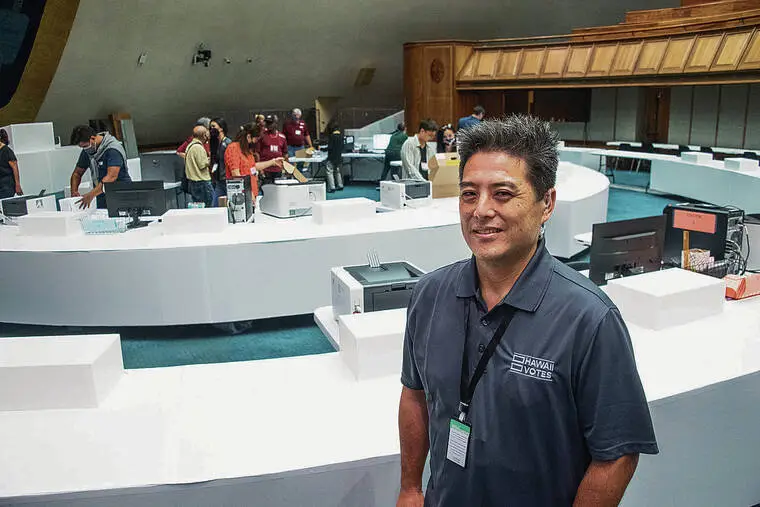
Hawaii lawmakers want a ‘Plan B’ if USPS won’t deliver ballots
The state Office of Elections is banking on the U.S. Postal Service and judicial system to ensure that Hawaii residents can easily vote in November’s general election, but some state lawmakers are worried over the lack of a contingency plan.
Read more ‘It was a really special moment for me’: Imonen, Oka sweep the 2026 Triple Crown Race Series
The state Office of Elections is banking on the U.S. Postal Service and judicial system to ensure that Hawaii residents can easily vote in November’s general election, but some state lawmakers are worried over the lack of a contingency plan.
Scott Nago, the state’s chief elections officer, told members of two legislative committees Wednesday that he can’t realistically fathom a court undoing a July 1 ruling by a federal judge, which blocked a presidential directive to the USPS that could disrupt voting by mail nationwide, before the Nov. 3 general election.
Still, two lawmakers wanted to know if there is a backup plan in even a highly unlikely event that the USPS carries out the wishes of President Donald Trump over mail-in voting.
Nago initially dismissed the question as being too hypothetical. But Sens. Brenton Awa (R, Kaneohe-Laie-Mokuleia) and Karl Rhoads (D, Nuuanu-Downtown-Iwilei) pressed the issue.
“If you’re sitting here and telling me, ‘That’s an option, but we don’t think it would ever happen,’ but you’re not prepared in the office to do something, then that’s a problem for us,” said Awa, minority leader in the Senate.
“Say the hypothetical occurs, and the USPS just refuses to deliver ballots,” added Rhoads, chair of the Senate Judiciary Committee. “Even if you wanted there to be a Plan B, is there a possible Plan B?”
Nago said two options are opening more voter service centers for in-person voting, or arranging for private package delivery services such as FedEx, UPS and perhaps others to deliver ballots.
“We’re going to have to do something because … our mission is to provide convenient, accessible and secure election services,” he said. “We’re committed to do that. So, if it comes down to that, that’s something we’re going to have to do.”
The discussion occurred during a briefing at the state Capitol from Nago on Hawaii’s election process requested by the Judiciary Committee led by Rhoads and the House Judiciary and Hawaiian Affairs Committee chaired by Rep. David Tarnas.
The briefing, scheduled over a week ago, was held a day after the U.S. Justice Department sent letters to the top elections official in every state, including Nago, warning that they could be subject to criminal liability for knowingly retaining noncitizens on a state’s voter list or for facilitating noncitizens receiving and casting ballots.
The letters ask for a response within five days that includes details on how each state intends to comply with longstanding federal law that bars noncitizens from voting.
Read more HPD changes its stance on medical marijuana cards and guns
Nago has said that his office complies with federal and state election laws, and that the request for a response was weird.
Under the U.S. Constitution, states are assigned to carry out elections. Under federal and state law, it is illegal for noncitizens to vote or register to vote, and there have been no widespread substantiated instances of noncitizens voting in Hawaii, where state law requires people who register to sign an affidavit stating under penalty of a felony that they are a U.S. citizen as well as a Hawaii resident and at least 18 years old.
Trump has alleged that noncitizens voting in elections has corrupted the system.
On March 31, he signed an executive order requiring that lists of eligible voters, derived from data compiled by federal agencies, be provided to election officials in all states, and that ballots may only be sent through USPS to registered voters on the federal lists in specially designed ballot envelopes approved by USPS. Trump said his move was intended to stop “massive cheating.”
A federal judge in Washington, D.C., blocked the president’s order nationally on July 1 after another federal judge had ruled against it from being applied in about two dozen states that had sued.
Nago said an unexpected reversal would not affect Hawaii’s primary election on Aug. 8 because primary elections already have taken place in other states. But if a reversal were made, then it could affect delivery of general election ballots to registered Hawaii voters and/or completed ballots being sent to elections officials for tabulation.
In Hawaii, all registered voters receive a ballot by mail, and the vast majority of voting is done by mail even though voters have the option to cast ballots in person up to 10 days before the voting deadline.
Tarnas (D, Hawi-Waimea-Waikoloa) noted that voters with ballots still would be able to fill them out and deposit them in secure drop boxes around the state. But Nago said the bigger potential issue would be getting ballots to voters because he is uncertain whether private package carriers have the capacity to handle that.
In 2024, 95% of Hawaii voters — 551,036 out of 579,784 — voted by mail. The other 5%, representing 28,748 voters, cast their ballots in person.
About 723,000 ballots are expected to be mailed out to registered voters in Hawaii for this year’s primary and general elections.
For the primary election, registered voters should receive ballots by July 21. And for the general election, voters should receive ballots by Oct. 16.

Related Posts

Remembering Hawaii’s 9/11 victims

World Manta Day returns today
